
By Will Pendray
As the scent of cumin mingles with the beats of the Fugees, Whitecross Street Market in London’s EC1 buzzes with lunchtime crowds, despite rising food prices and economic uncertainty. Named after a white stone cross that marked the territory of the Knights Hospitaller, a 12th-century military order tied to the Crusades. This street is just a stone’s throw from their former Clerkenwell headquarters. Once a symbol of Christian expansionism, its name now evokes a history better left in the Dark Ages, considering today’s troubles.
It’s hard to imagine this bustling market as a place once defined by knights bearing white crosses, symbols of religious conflict in the Holy Land, now known as Israel and Palestine. The battle here has shifted from religious conquest to surviving recent economic pressures and the cost of living.
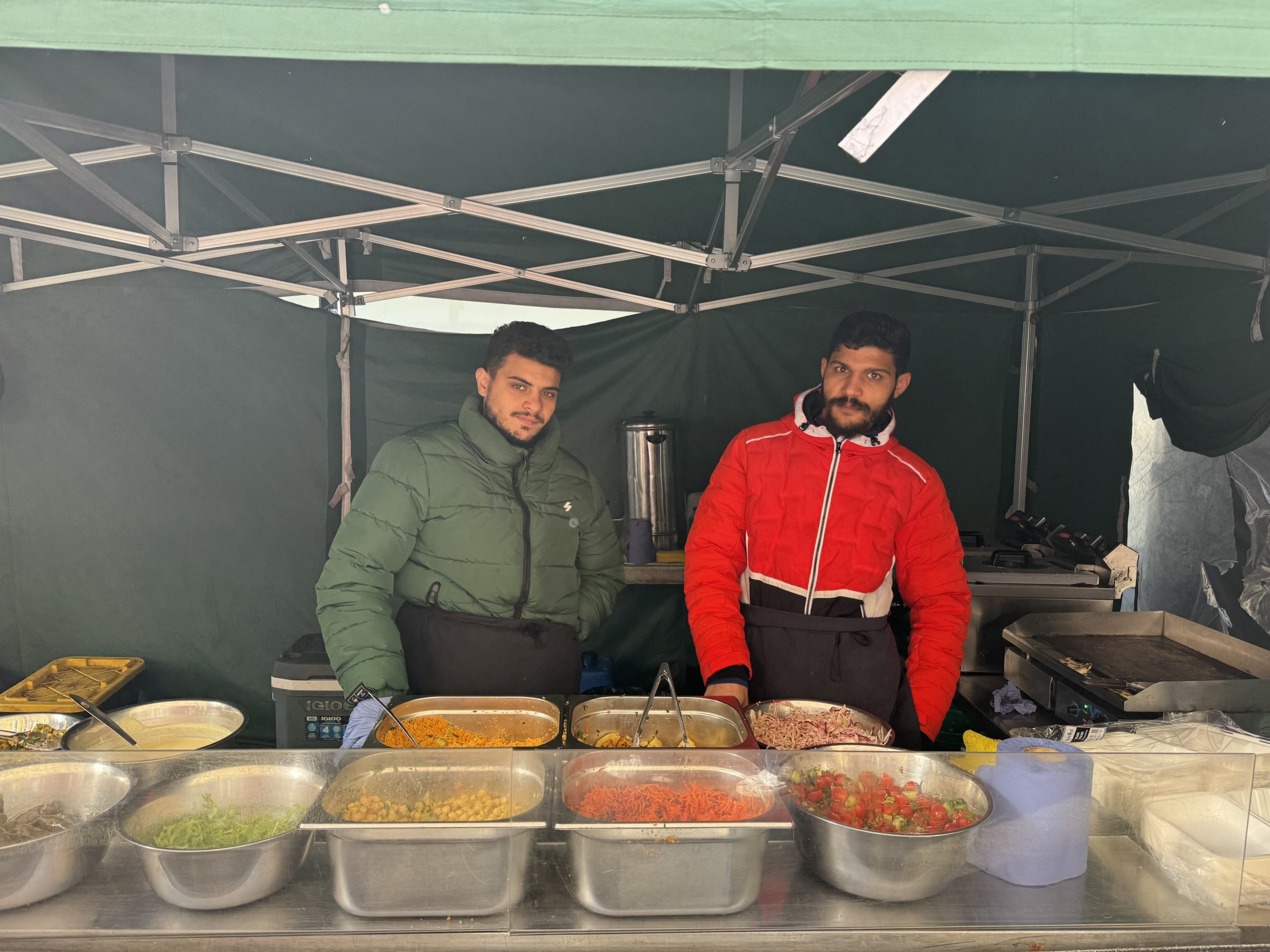
In stark contrast to the Christian orders of the past, this historic street has transformed into a vibrant marketplace that celebrates cultural diversity. Stallholders offer a variety of international dishes, from Middle Eastern to South Asian cuisine. Among them is Ibrahim Charif, a 25-year-old Palestinian who arrived at Whitecross Market through a Lebanese friend.
Ibrahim’s falafel stall offers a taste of home. More than just serving fresh vegetarian options, his stall represents a quiet resistance against the turmoil in his homeland. These familiar flavours in London serve as a powerful reminder of the strength found in preserving cultural identity, especially amidst the ongoing atrocities faced by Palestinians.
Like many traders, Ibrahim has felt the impact of economic difficulties shaped by the pandemic. “People used to be able to afford salad and a wrap,” he tells me, “But now it’s one or the other.” Over the past three years, food prices have risen by 30.6% according to the Office for National Statistics, forcing customers to make tough choices at the market. The two-hour lunch rush has slowed, leaving sellers like Ibrahim uncertain about the future. Yet, despite the challenges, resilience amongst stallholders shines through, as they strive to keep this historic market alive.
Ibrahim’s dreams of expanding his falafel stall to include meat options have been stifled by council regulations, and he wonders whether the market has room for new ideas. As he navigates both the pressures of long-standing competition and the post-pandemic recovery, his story mirrors the larger question: what does the future hold for London’s oldest surviving street market?
With its layers of history and rich multiculturalism, Whitecross Market stands as a symbol of how London has changed, and how food can unite what centuries of conflict tried to divide.