
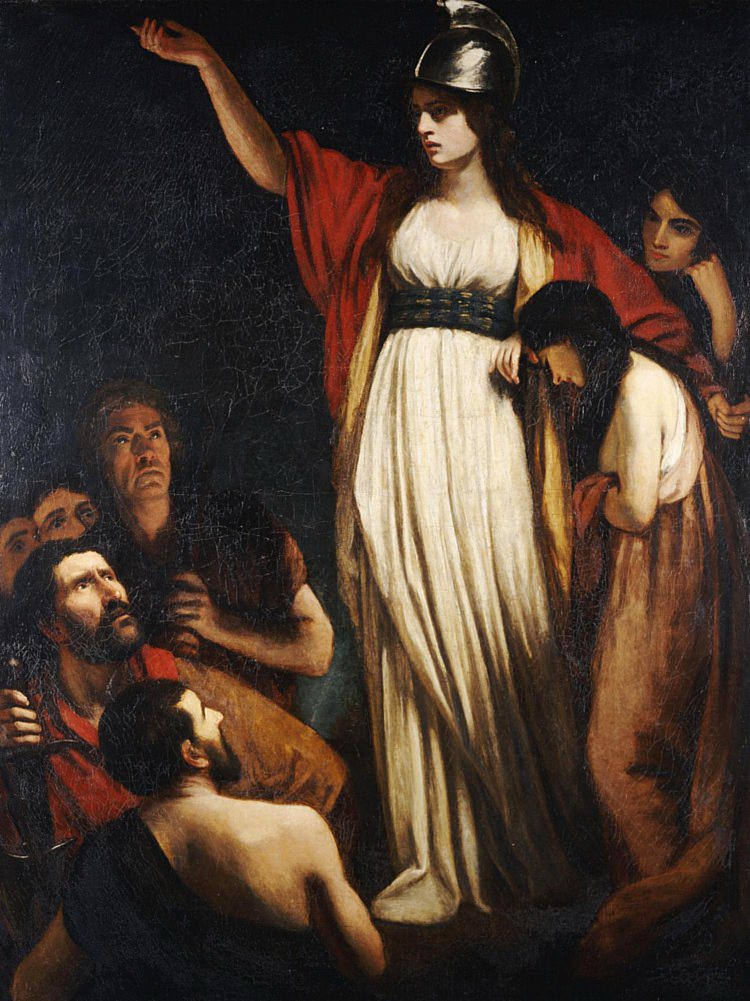
Old Street is believed to have been the site of a massacre. Not caused by arguments on the streets over the frequently non-running Northern Line, but by Queen Boudica (or Boadicea) and her Iceni tribe attacking newly developing Londinium in A.D. 60.
Although the road was first mentioned by name in 1200, as Ealdestrate, becoming Old Street in the 1300s, it was known to have even predated the Roman invasion of AD 42 as a prehistoric track stretching from west to east ran along the route. London itself was not a thriving town before the Roman invasion, the major capital in the South East of England was Colchester, but it was Romans who created a major settlement given the potential of the River Thames for ships to dock. By AD 60 it had grown significantly, but there was no city wall.
Boudica’s tribe from East Anglia rose up against the Roman invaders after she and her daughters were raped and robbed by troops, and having marched on and destroyed both Colchester and St Albans, they attacked London, pillaging and burning. The Roman army had fled along with most Roman civilians, but leaving behind Britons who had fitted in with the Roman lifestyle. They, perhaps, expected mercy but found none, and headless bodies from Boudica’s raid are still found in the Thames.
However once their fate was clear, the Londoners did try to get away and historians believe that many headed along Old Street, some trying to go north, towards York as a new road had been built from what is now the station roundabout, and others fleeing west but they did not get far and were massacred, their bodies burnt.
Whilst the City of London was quickly rebuilt after Boudica’s revolt was equally brutally ended, it took 130 years before the Romans got around to putting defences around this city that was growing in importance, until AD 190. Very similar to the speed taken for major public works in the 21st Century. Old Street then became a popular route as a bypass of the city.
Boudica is of course now considered a hero of British resistance to an invading army, even though the majority of those she killed were British, and the statue of her and her two daughters stands on the bank of the Thames opposite the Houses of Parliament. The skeletons of her victims still lie in the river that flows past and may not be convinced of the justice of her status today.
Image. Painting by John Opie, 1761 to 1807